Empathy Statements for Customer Service (30 Examples + Tips)
TL;DR: Empathy statements help customer support agents acknowledge a customer’s feelings, stay out of judgment, and build trust. This guide explains what empathy statements are, how to use them, and includes 30 ready-to-use examples grouped by situation.

What are empathy statements in customer service?
Empathy statements are short phrases that recognize and validate a customer’s emotions during a support interaction. They help agents communicate understanding, reduce tension, and create a human connection between the customer and the business.
How do you show empathy in customer service?
Empathy can be hard to apply in the moment. A simple framework is to:
- Recognize the customer’s experience and perspective.
- Stay out of judgment.
- Identify the emotion the customer is expressing.
- Communicate that recognition in plain language.
Using this approach consistently helps turn empathy from theory into a repeatable skill.
What is an example of an empathy statement?
Different situations call for different phrases. Below are 30 examples grouped by common customer service scenarios. Use placeholders like [Issue], [Product/Service], and [Timeframe] to tailor each statement.
Communicating Understanding
- If this happened to me, I’d feel the same way.
- I’ve had a similar experience, and I understand how that can feel.
- I appreciate you bringing this to my attention.
- I can see how complicated this is.
- I see you’ve been with [Company] for [X years]—thank you for your loyalty.
- I’m sorry you’ve had to deal with this.
- That would frustrate me too.
- I’d be asking the same questions.
- I can see why you’d come to that conclusion.
- I’m truly sorry to hear about your experience.
- I understand how frustrating this must be.
- I’m sorry you’re dealing with this problem.
- I understand this has been inconvenient—and really annoying.
- Thanks for your patience. I know you likely have better things to do today.
Reassuring the Customer
- I appreciate your patience.
- Thank you for staying positive while we work through this.
- Your business means a lot to us.
- Thank you for taking the time to speak with me today.
- If I’m understanding you correctly, [restate issue].
- Let me make sure I’ve got this right: [restate issue].
Dealing with Difficult or Angry Customers
- I can imagine how upsetting this would be.
- You’re right to bring this up.
- What can I do right now to make your experience better?
- I understand why this is upsetting.
- You’re absolutely right—and I appreciate you calling it out.
Providing Solutions
- What would a best-case outcome look like for you?
- Is there anything else—big or small—I can help with today?
- How do you feel about [proposed option]?
- Are your [X needs] being met with our [product/service]?
- Going forward, we’ll focus on [next step] to help prevent this from happening again.
How to sound sincere when using empathy statements
Empathy can’t be faked—customers can usually hear insincerity. The goal is to pair an empathy phrase with genuine listening, clear next steps, and respectful tone.
Six tips to sound more sincere
- Avoid clichés. Use specific language that matches what happened.
- Skip filler words. Don’t add “sincerely” unless it changes meaning.
- Keep it human. Don’t over-formalize your message.
- Say what you mean. Remove vague “weasel words.”
- Use clean grammar and punctuation.
- Only say what you believe. Customers can tell when you’re reading a script.
The art of listening to customers
One common cause of customer frustration is feeling unheard. Listening means focusing on both what customers say and how they say it, then clarifying with patience so they don’t have to repeat themselves.
Conclusion
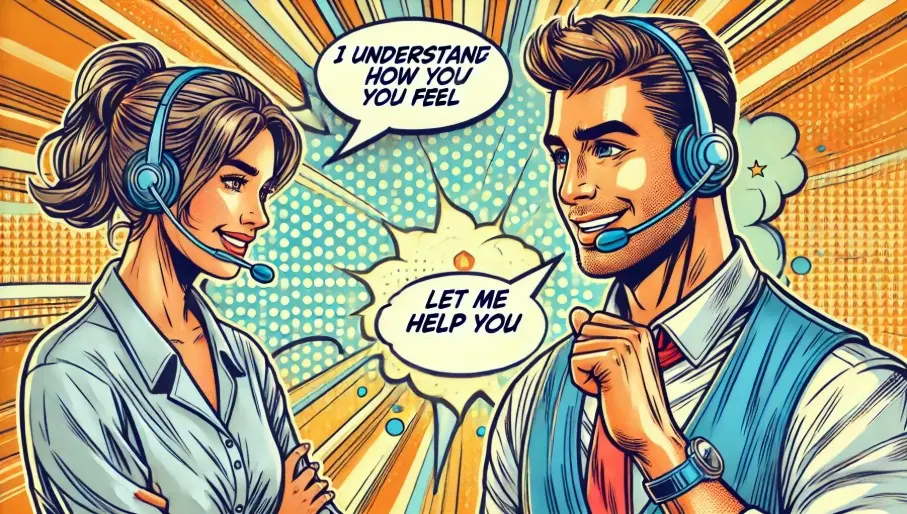
Empathy is one of the most effective ways to show customers you care—regardless of channel. It may not instantly solve the issue, but it builds trust and opens the door to resolution.
Quick examples: customer says → agent replies
- Customer: “This is ridiculous—I’ve been trying all day.”
Agent: “I understand how frustrating that is. Thanks for sticking with it, let’s fix this together.” - Customer: “I keep getting charged twice.”
Agent: “You’re right to flag that. I’m sorry you had to deal with it, here’s what I’ll do next.” - Customer: “I don’t trust this will be resolved.”
Agent: “That makes sense. I’d feel the same way. I’ll outline the exact steps and timing so you know what to expect.”