Explore our AI chatbot comparison of ChatGPT vs Gemini. See which is best for customer service, content creation, and technical support.
Summarize with AI:ChatGPTPerplexityGoogle AIClaude
Chatbots used to sound like robots - literally. But now? They're having full-on conversations, answering questions, and helping customers 24/7. We’re not in the future. We’re in the now.
If you’re wondering which AI is best for your chatbot needs, you’re not alone. It’s a common question. Two big names keep coming up: ChatGPT (by OpenAI) and Gemini (by Google). I’ve used both. My husband, who’s a software developer, uses Gemini daily. I use ChatGPT. We have very different jobs - and very different opinions. So I thought I’d share how we see it, what they’re great at, and how one of them powers a really smart chatbot we use at work.
What Is a Chatbot?
Back when I first heard the word "chatbot," I pictured a clunky pop-up asking, “How may I help you today?”. Only to offer zero help. Fast forward to today, and AI-powered chatbots can actually hold a conversation. They understand what you’re saying and remember what you asked earlier. It can also handle a bunch of tasks without needing a human on standby.
Whether you're using ChatGPT for live chat or exploring Gemini chatbot capabilities, these tools can:
- Respond to customer inquiries instantly
- Solve common problems (without passing it off to someone else)
- Save your team hours of repetitive work
It’s not just cool tech - it makes customer support smoother, faster, and more personal.
ChatGPT vs Gemini
A Quick History
- ChatGPT
- OpenAI’s ChatGPT has come a long way. The latest version (GPT-4o) is smart, funny, thoughtful, and weirdly good at writing in your tone. It handles long chats without getting confused and is already being used by over 800 million people a week. That’s wild.
- Gemini
- Gemini, on the other hand, is Google’s brainchild. The latest version - Gemini 2.5 Pro - can take in the equivalent of 1,500 pages of info at once. It’s also multimodal, which means it can handle text, audio, video, images… basically anything you throw at it.
Strengths and Use Cases
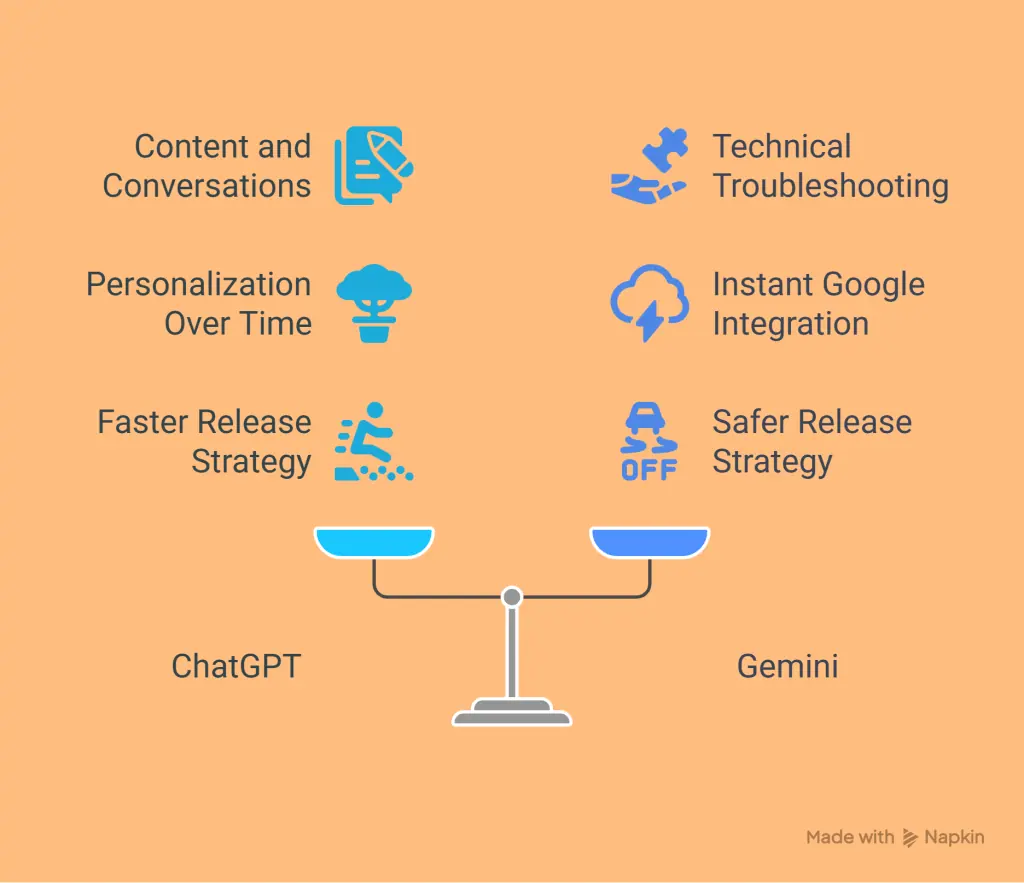
- ChatGPT: It’s amazing for content, conversations, social media captions, and just about anything where tone and nuance matter. As a writer, this is my go-to.
- Gemini: It’s great for technical stuff. My husband uses it to troubleshoot code, analyze databases, and get quick summaries from massive documents. It’s fast, efficient, and very logical.
Personalization and Context Handling
ChatGPT “learns” you over time. It remembers your preferences if you let it. Gemini pulls info instantly from your Google services (like Gmail and Docs) if you connect them, so it feels like it already knows you.
Data Privacy, Bias, and Reliability
Both AIs have their quirks. Some users have noted that both tools occasionally reflect viewpoints that seem more progressive, depending on the topic or question. Google plays it safer with releases; OpenAI tends to move faster. Either way, you should still double-check anything sensitive.
Usage Statistics
- Gemini is projected to hit half a billion user by the end of 2025.
- 800 million people use ChatGPT weekly.
If you’re curious to explore them more, check out OpenAI or Google Gemini.
Choosing Based on Your Role: Our Experience
At home, it’s a bit of a tech divide - but in the best way. My husband is a software developer who works with systems and code all day. He’s constantly building, fixing, or streamlining something. For him, Gemini is like having a brilliant second set of eyes - especially when he's neck-deep in debugging or tackling a tricky build. He says it helps him think faster and work cleaner.
As for me, I write. A lot. I'm a content writer and SEO specialist, which means I spend most of my time brainstorming headlines, drafting blog posts, or figuring out how to turn ideas into helpful articles. ChatGPT is my daily companion. It helps me think through topics and reword things when my brain hits a wall. And honestly, it makes writing more fun.
It’s funny how we each found the tool that fits how our brains work. His AI helps him problem-solve. Mine helps me communicate.
It's less about which one is "better" and more about which one fits you.
LiveHelpNow's HUE: Powered by ChatGPT and Claude by Anthropic
At LiveHelpNow, we didn’t want just another chatbot that spits out canned responses. We needed something smarter. More intuitive. More… human. So we built HUE.
HUE is our AI-powered assistant, and it’s not just backed by one engine - it taps into leading AI models like ChatGPT and Claude by Anthropic, giving it a broad range of conversational capabilities.
Here’s what it helps us do:
- Reply to customer chats with warmth and accuracy
- Automatically escalate tricky questions to live agents
- Build and update our knowledge base on the fly
- Suggest helpful replies that save our team time
- Deliver fast, smart, and friendly support experiences
- HUE can also automatically reply to emails with highly accurate answer.
And the best part? HUE works 24/7 - no coffee breaks, no forgetting, just consistent support.
With so many AI options available today, we’ve built HUE to stay flexible and future-ready - powered by the best, tailored for real customer needs.
Want to meet HUE? Head over to LiveHelpNow and click that little chat bubble. 😉
Trending Now: AI Isn’t Slowing Down - It’s Getting Smarter by the Day
If it feels like AI is everywhere lately, you're not imagining it. These new reasoning models - like ChatGPT’s latest updates, Google’s Gemini, and xAI’s Grok 3 - aren’t just impressive, they’re becoming quietly essential. They can answer complex questions, search the web, and give you smarter, more useful responses in less time. ChatGPT, for example, jumped from 300 million to 500 million users in just three months. And it’s easy to see why. People are using it for everything - summarizing articles, writing emails, planning trips, even picking dinner spots. It’s not just a tech trend anymore. For a lot of us, it’s part of how we get through the day.
Conclusion
There’s no “best” AI chatbot - just the right one for your needs. Choosing the right AI tool depends on what you need most.
If you’re handling customer service and want your chatbot to sound helpful, friendly, and human? ChatGPT is your winner.
If you’re knee-deep in technical work and need logic, structure, and a massive memory bank? Gemini is probably your best bet.
We’re living in a time where you can pick the kind of intelligence you want to work with. And for our team? ChatGPT, through HUE, helps us deliver customer support that feels less like a bot - and more like a real conversation.
Frequently asked questions
Which is better for a customer service chatbot, ChatGPT or Gemini?
The post finds no single best AI, only the right one for the job. For customer service, where a chatbot should sound helpful and friendly, it recommends ChatGPT, which is strong on tone and nuance. For technical work that needs logic, structure and the ability to process very large documents, Gemini is likely the better choice.
What is Gemini best used for?
Gemini, built by Google, is strong at technical tasks such as troubleshooting code, analyzing databases and summarizing very large documents. The post says Gemini 2.5 Pro can take in the equivalent of 1,500 pages at once and is multimodal, which means it can work with text, audio, video and images.
How do ChatGPT and Gemini personalize their responses?
ChatGPT can learn and remember your preferences over time if you allow it, which makes it good at writing in your tone and following long conversations. Gemini feels personal in a different way: when you connect Google services such as Gmail and Docs, it pulls information from them instantly.
What can an AI chatbot do for customer support?
A modern AI chatbot can hold a real conversation, understand what customers say and remember what they asked earlier. It can respond to inquiries instantly, solve common problems without passing them to someone else, and save the support team hours of repetitive work, making support smoother, faster and more personal.
Are ChatGPT and Gemini reliable enough for sensitive information?
Both tools have quirks, and the post advises double-checking anything sensitive whichever one you use. Google tends to be more cautious with its releases while OpenAI moves faster. Some users have also noticed that both occasionally reflect particular viewpoints depending on the topic or question.